
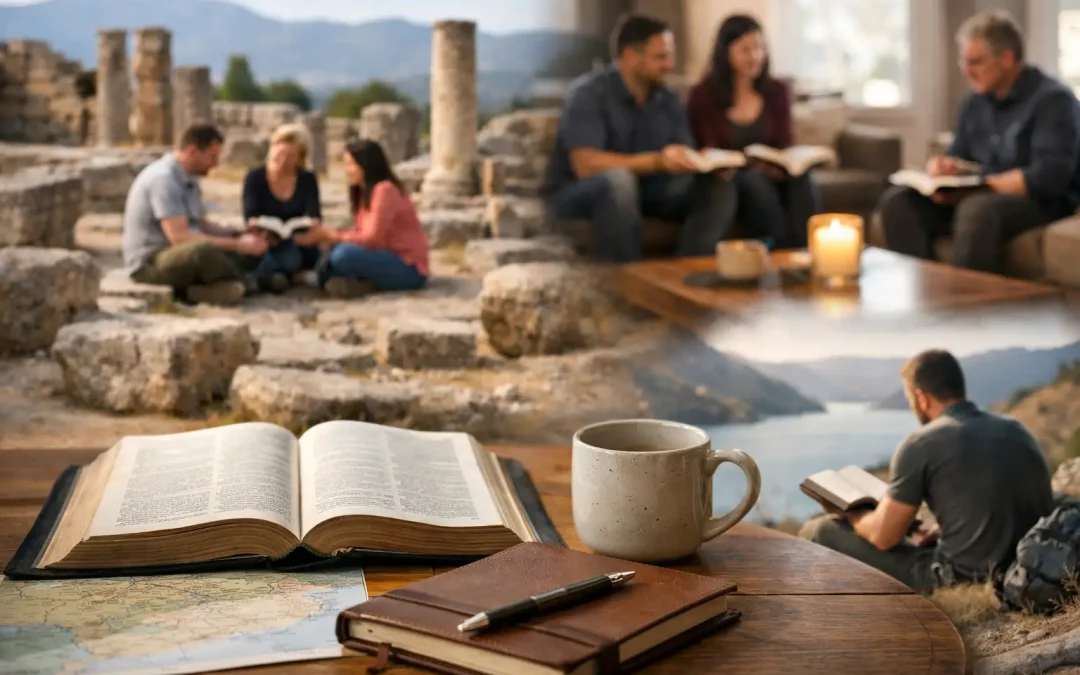
Understanding more about Bible study locations can change the way we read the Bible. Cities stop feeling like names on a page. Roads, prisons, and meeting places start to feel real.
Why Acts Bible Study Locations Matter
Acts is a story of movement. The message of Jesus moves. When the locations are understood, the pressure of the story becomes clearer. Travel took time. Seas were dangerous. Cities had strong local beliefs. Opposition did not happen in a blank space. It happened in public streets, synagogues, marketplaces, and courts.
That also helps with personal Bible study. A reader can see that the Gospel did not grow in easy settings. It moved through tension, delay, and hardship. That gives courage for daily faith. The same Lord who guided the early church through crowded cities and hostile rulers still leads His people now.
A simple verse in Acts gives the big picture: “But the Holy Spirit will come on you and give you power. You will be my witnesses in Jerusalem, in all Judea, in Samaria, and in every part of the world” (Acts 1:8).
Key Acts Bible Study Locations to Know
Jerusalem
Jerusalem is the starting point of Acts. Jesus ascends from near this city. The believers gather there. Pentecost happens there. The early church grows there.
This location matters because Jerusalem ties Acts to the promises of the Old Testament and to the death and resurrection of Jesus. The church is not born in isolation. It begins in the city already filled with worship, conflict, and expectation. When reading Acts, Jerusalem reminds the reader that the Gospel is rooted in real history.
Jerusalem is also where pressure first rises. Arrests, threats, and public questions begin there. So the city holds both joy and cost. It is a place of prayer, preaching, and suffering.
Judea and Samaria
These regions are not just background. They show the widening reach of the Gospel. After persecution in Jerusalem, believers scatter. Philip goes into Samaria, and the message is received there with joy.
This part of Acts matters because the church is pushed outward. Growth does not happen only through comfort. The spread into Judea and Samaria shows that God uses hard moments to move His mission forward.
Samaria also matters because it shows barriers being crossed. Old divisions do not get the last word. Jesus had already pointed in this direction, and Acts shows it happening in public life.
Damascus
Damascus is remembered for one major reason. On the road to Damascus, Saul meets the risen Christ. The persecutor becomes a servant of Jesus.
That location matters because it marks one of the great turning points in Acts. Without Damascus, the reader misses the force of Saul’s change. He was not lightly adjusted. He was fully redirected.
For Bible study, Damascus is a reminder that Jesus is able to reach a person in motion, in pride, and in resistance. Acts does not present changed lives as self-improvement. It presents them as the work of Christ.
Antioch
Antioch becomes one of the most important cities in Acts. It is a strong church center. It is also the sending place for mission. From Antioch, Apostle Paul and Barnabas are sent out.
This city matters because it shows a healthy church in action. Antioch prayed, fasted, and sent. It did not keep all its gifts to itself. It became a base for outward ministry.
Acts also says the disciples were first called Christians in Antioch. That detail gives the city added weight. It connects identity, mission, and public witness.
The Main Cities on Apostle Paul’s Journeys
Philippi
Philippi is a Roman colony in Macedonia. In Acts, it is the place where Lydia believes, a slave girl is freed, and Paul and Silas are jailed.
This city helps readers see the mix of ministry in Acts. There is openness, conflict, and rescue all in one setting. The prison scene in Philippi is not just dramatic. It shows that praise can rise in a place of pain.
Philippi also shows that the Gospel reaches households, workers, and officials. That range matters. Acts does not stay inside one social group.
Thessalonica
Thessalonica was a busy city with a key road running through it. That helps explain why ministry there drew attention fast. A public city can spread news quickly, for good or for harm.
In Acts, the message produces belief and unrest. This pattern repeats in several places. The location helps explain why. Big trade cities had influence. They also had strong reasons to resist change.
When studying Thessalonica, it helps to notice how quickly the Gospel was discussed in public life. Faith was not treated like a private hobby.
Corinth
Corinth was known for trade, wealth, and moral confusion. In Acts, Apostle Paul stays there for a longer stretch than in many other cities.
This location matters because it shows patient ministry in a hard setting. Corinth was strategic, but it was also messy. That gives hope to any reader serving Christ in a broken culture.
The city also sat between major travel routes. That made it a strong center for influence. A church planted there could carry the message far beyond one neighborhood.
Ephesus
Ephesus stands out in Acts because it was a major city with deep religious identity. Apostle Paul’s ministry there touched daily life so strongly that it stirred public reaction.
This matters because Ephesus shows the Gospel confronting idols at the center of a city’s economy and worship. The issue was not just personal belief. It touched money, power, and public loyalty.
For Bible study, Ephesus makes one truth plain. When Jesus is preached clearly, change reaches deeper than words. It can disrupt false worship and expose what people trust most.
Rome
Acts ends with Apostle Paul in Rome. That is not a small detail. Rome was the center of imperial power. The Gospel had traveled from Jerusalem to the heart of the empire.
This location matters because it shows that the message of Jesus was not stopped by chains, storms, or trials. Acts closes with the sense that the Gospel is still moving. The book ends in a way that points forward.
Rome also reminds the reader that God’s mission reaches great cities as well as small gatherings. No place is beyond His reach.
How to Study Acts Locations Well
A good way to study Acts Bible study locations is to read slowly and ask simple questions. Where is this event happening? Why would this city matter? What kind of pressure might believers have faced there?
It also helps to notice movement. Watch when the story shifts from one city to another. Pay attention to ports, roads, and regions. Travel details are not filler. They show effort, danger, and purpose.
Maps can help, but the goal is to read Acts with clearer eyes and a warmer heart.
What These Places Mean for Faith Today
Acts Bible study locations do more than explain history. They remind Christians that faith is lived in real neighborhoods, real workplaces, and real pressure. Jerusalem had tension. Philippi had a prison. Ephesus had idols. Rome had power.
The same Gospel met people in every one of those settings. That is why these places matter. They show that Jesus is Lord in sacred spaces, public spaces, and hard spaces.
Readers who enjoy learning Scripture through real locations may also appreciate the way John Christopher Frame connects biblical geography with spiritual growth through faith-centered teaching and resources.
Acts becomes more vivid when its locations are taken seriously. Not because the map is the message, but because the map helps show where the message went, what it faced, and how faithfully the Lord carried it forward.