
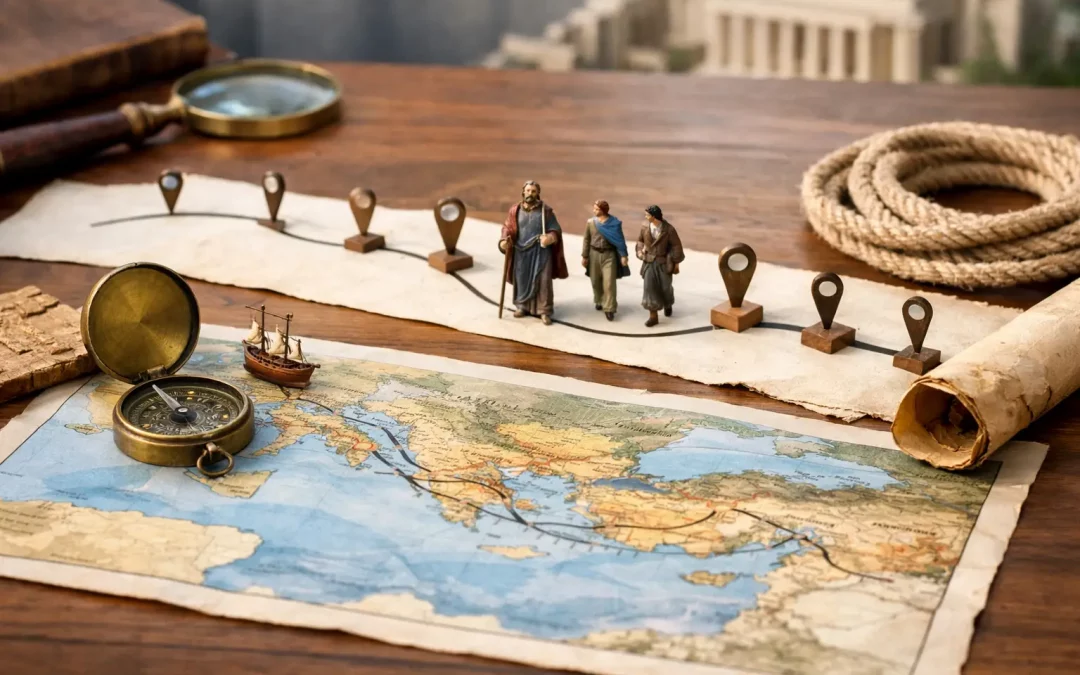
Ever start reading Acts and feel like Paul never slows down as he goes from one city to the next?
He goes to so many cities: Damascus. Antioch. Cyprus. Philippi. Corinth. Ephesus. Rome, and more.
It can start to feel like a fast-moving map.
A simple timeline can help. When you know the basic order of Apostle Paul’s travels, Acts becomes easier to follow. You can see where Paul went, why some places mattered, and how the Gospel moved from city to city.
Paul’s journey timeline in simple order
A clear way to follow Apostle Paul is to trace his life in stages.
First came his conversion. Then came years of growth and service. After that came three major missionary journeys. Finally, Paul traveled to Rome as a prisoner.
Acts 9 records the turning point. Saul, later called Paul, met Jesus on the road to Damascus. That changed his whole direction. The man who had attacked believers became a messenger of Christ.
After his conversion, Paul spent time in Damascus and Arabia. Later, he worked with believers in places like Antioch. Antioch became a key sending church. From there, the missionary journeys began.
1. Paul’s first journey
Paul’s first journey begins in Acts 13. He traveled with Barnabas and John Mark. They were sent out from Antioch and sailed to Cyprus, then moved into parts of Asia Minor, in modern-day Turkey.
Key stops on this trip include Salamis, Paphos, and Pisidian Antioch. Paul often preached first in synagogues. Then, when many rejected the message, he also turned to Gentile hearers.
At one point, John Mark left Paul and Barnabas and returned to Jerusalem.
This trip also included Iconium, Lystra, and Derbe. In Lystra, Paul was attacked and left for dead, yet he got up and kept going, showing the cost of the mission.
The first journey showed a pattern you can follow through Acts. Paul entered a city, preached Christ, gathered believers, strengthened the new church, and moved on.
2. Paul’s second journey
Paul’s second journey begins in Acts 15 after a sharp disagreement between Paul and Barnabas. Paul traveled with Silas, and later Timothy joined them. This journey pushed farther west and carried the Gospel into Europe.
Paul first revisited churches from the earlier trip. That was pastoral work, not just travel. He wanted believers to grow strong.
Then Acts records a key moment. Paul saw a vision calling him to Macedonia. That led him across the sea to Philippi, Thessalonica, and Berea. These cities were major steps in the spread of the Gospel.
Philippi stands out. Lydia believed there. A jailer also came to faith after Paul and Silas were imprisoned. Before that moment, Paul and Silas said, “Believe in the Lord Jesus and you will be saved—you and all the people in your house” (Acts 16:31).
From Macedonia, Paul went to Athens and then Corinth. In Athens, he spoke to people shaped by many ideas and beliefs. In Corinth, he stayed longer and helped establish a church in a busy trade city.
3. Paul’s third journey
Paul’s third journey begins near the end of Acts 18. This trip focused more on building up existing churches. Paul still traveled widely, but there was extra attention on teaching and strengthening believers.
Ephesus became the center of this journey. Paul spent significant time there. That helped the Gospel reach a wider region because Ephesus was a major hub.
Acts 19 shows both fruit and conflict in Ephesus. Many people believed. At the same time, opposition grew because the Gospel challenged local idols and business interests. At one point, there was a huge riot in Ephesus with people very angry at Paul.
After Ephesus, Paul traveled through Macedonia and Greece again. He encouraged believers and prepared to return toward Jerusalem. Along the way, he also warned church leaders that hardship was ahead.
4. Paul’s final trip to Rome
Paul’s timeline does not end with the third missionary journey.
After returning to Jerusalem, Paul was arrested. That led to trials, danger, and a long journey under guard.
He was taken by sea toward Rome. Acts 27 and 28 describe storms, shipwreck, and survival on Malta before he finally reached Rome. Even in chains, Paul kept speaking about Jesus.
This final stage shows something important. The mission was not stopped by prison. The Gospel still moved forward.
Understanding Paul’s timeline can help your Bible reading
When you know the order of Paul’s journeys, Acts becomes easier to follow. You can connect cities to people and events.
Philippi connects to Philippians. Corinth connects to 1 Corinthians and 2 Corinthians. Ephesus is connected with Ephesians.
You also begin to see the distances involved. Paul crossed land and sea, faced danger, and kept going back to young churches.
A simple way to remember Paul’s timeline
It might be helpful to remember Paul’s timeline in five parts:
conversion, first journey, second journey, third journey, Rome.
That simple frame can help when you read Acts or study one of Paul’s letters.
If you want one main thread to hold onto, it is this: Paul kept carrying the Gospel outward while also caring for the people who received it–mission and discipleship together.
Paul’s timeline is not just a list of stops. It can help you see how God worked through one person’s faithful witness, one city at a time.