
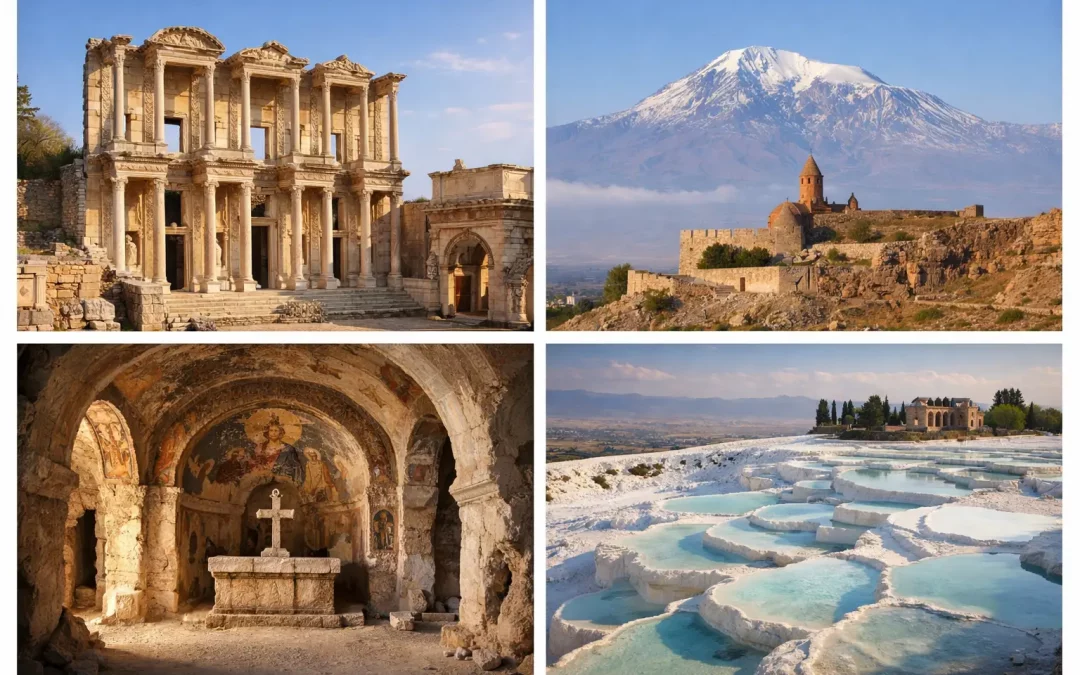
What happens when the names in Acts and Revelation stop feeling distant and start feeling real? That’s part of why biblical sites in Turkey matter so much. These places are not just dots on a map. They remind readers that the gospel moved through real streets, real homes, and real cities filled with real need.
Turkey holds some of the most important locations in the New Testament world. Apostle Paul traveled through this region more than once. Early churches took root there. The book of Revelation addressed several congregations in this land. For Christians who want the Bible to feel more grounded, Turkey is one of the clearest windows into the early church.
Why biblical sites in Turkey matter for faith
There’s a difference between reading about Ephesus and remembering it was a major city with public roads, trade, pressure, and idols. There’s a difference between hearing that Paul suffered opposition and picturing the crowded Roman world where that happened. The setting doesn’t replace the message of scripture, but it can sharpen attention.
That matters for spiritual growth. When a reader sees that the early church lived in complicated cities, faith can stop feeling like something fragile or private. The first Christians followed Jesus in public life. They faced power, temptation, confusion, and hardship. That sounds familiar.
At the same time, not every site offers the same kind of insight. Some places are dramatic and well preserved. Others require more imagination. A few sites are debated in their exact details. That’s part of visiting Bible lands in general. The value is not in claiming certainty about every stone. The value is in seeing the world where the gospel spread.
Ephesus and the world of Apostle Paul
If one site stands above the rest, it is Ephesus. This city appears again and again in Christian study because it was central to the ministry of Apostle Paul and later to the life of the church. It was wealthy, busy, and deeply shaped by pagan worship, especially the temple of Artemis.
Reading Acts 19 after learning about Ephesus brings the tension into focus. Paul did not preach in a vacuum. He spoke in a city where economics, religion, and identity were all tied together. That helps explain the uproar around his ministry. The gospel challenged more than private belief. It disrupted false worship and exposed what people trusted.
Ephesus also appears in Revelation as one of the seven churches. That adds another layer. A church could be hardworking and discerning, yet still be warned about leaving its first love. Place and message meet each other there in a powerful way.
Antioch of Pisidia and bold gospel preaching
Antioch of Pisidia is one of the key stops on Paul’s missionary journey in Acts 13. It may not be as famous as Ephesus, but it matters deeply. This was a place where Paul preached in the synagogue and clearly announced Jesus as the promised Savior.
The response was mixed. Some listened with joy. Others pushed back hard. That pattern shows up often in Acts, and Antioch of Pisidia makes it very plain. The gospel draws people in, but it also confronts pride and religious resistance.
For believers today, this site gives courage. Faithful witness does not always lead to easy results. Sometimes it leads to hunger for truth. Sometimes it leads to rejection. Both happened in the ministry of Apostle Paul.
Iconium, Lystra, and Derbe
These cities are often grouped together because they help tell the story of endurance. In Iconium, Paul and Barnabas preached and faced division. In Lystra, Paul was mistaken for a god and then later attacked by a crowd. In Derbe, the gospel kept moving forward.
That sequence is striking. Human praise can turn into hostility very fast. Ministry can look fruitful one day and painful the next. Yet the mission continued.
Lystra also connects to Timothy, whose story later becomes important in the New Testament. That reminder matters. Some of the fruit of ministry is not visible right away. A city may seem like a place of hardship, but God may be raising up future servants there.
The seven churches of Revelation in Turkey
Several of the best-known biblical sites in Turkey are tied to Revelation chapters 2 and 3. These churches were in real communities facing real pressures. Ephesus, Smyrna, Pergamum, Thyatira, Sardis, Philadelphia, and Laodicea each received a message from Christ.
That alone is worth pausing over. Jesus addressed actual congregations in actual towns. He knew their trials. He knew their weaknesses. He called them to remain faithful.
Smyrna and faithful suffering
Smyrna stands out for its call to endurance under suffering. Not every church was rebuked. Some were encouraged to stay faithful through hardship. That message still strengthens Christians facing pressure, grief, or fear.
Pergamum and compromise
Pergamum helps readers think about spiritual compromise. It was a place of influence and power, but also deep pagan loyalty. The church there was called to hold tightly to truth. That tension still exists in modern life. It’s possible to live in a culture full of pressure without letting go of Christ.
Laodicea and spiritual complacency
Laodicea is often remembered for being lukewarm. The image is memorable because it speaks to a real danger. Comfort can make faith dull. Self-sufficiency can hide spiritual need. Among biblical sites in Turkey, Laodicea may be one of the clearest warnings for comfortable believers.
Colossae and the unseen places
Colossae is less visually impressive today than some other sites, but its biblical importance is still strong. The letter to the Colossians gives readers one of the richest pictures of Christ in the New Testament. Even if the ruins are less famous, the spiritual weight of the place remains.
This is a good reminder that not every meaningful Bible location will be dramatic. Some sites ask for reflection more than spectacle. Sometimes the strongest connection comes through reading the letter connected to a place and remembering it was first heard by a gathered church in that setting.
What these places teach beyond history
The best reason to care about these places is not travel trivia. It’s discipleship. Biblical geography can train the heart to read scripture with more patience and more wonder. It can also correct the idea that Christianity spread in safe conditions. It did not. The church grew in cities full of idols, trade routes, political pressure, and spiritual conflict.
That reality can encourage any believer trying to follow Christ in a confused culture. The New Testament world was not simple. Yet Jesus was building His church there.
One verse captures that steady hope: “The Lord’s message was spreading and becoming more powerful” (Acts 19:20).
That happened in places like Ephesus. It happened through hardship. It happened through ordinary obedience. And it still speaks today.
If visiting Turkey is not possible
Not everyone will travel to these places, and that’s okay. The spiritual value is not limited to boarding a plane. Reading Acts with a map nearby can help. Studying the seven churches of Revelation with attention to their setting can help too. Even a simple Bible places quiz can make names that once felt distant start to connect.
Biblical sites in Turkey remind believers that the gospel has always moved through ordinary places filled with broken people and urgent need. That means no street, workplace, or city is beyond the reach of Christ today.