
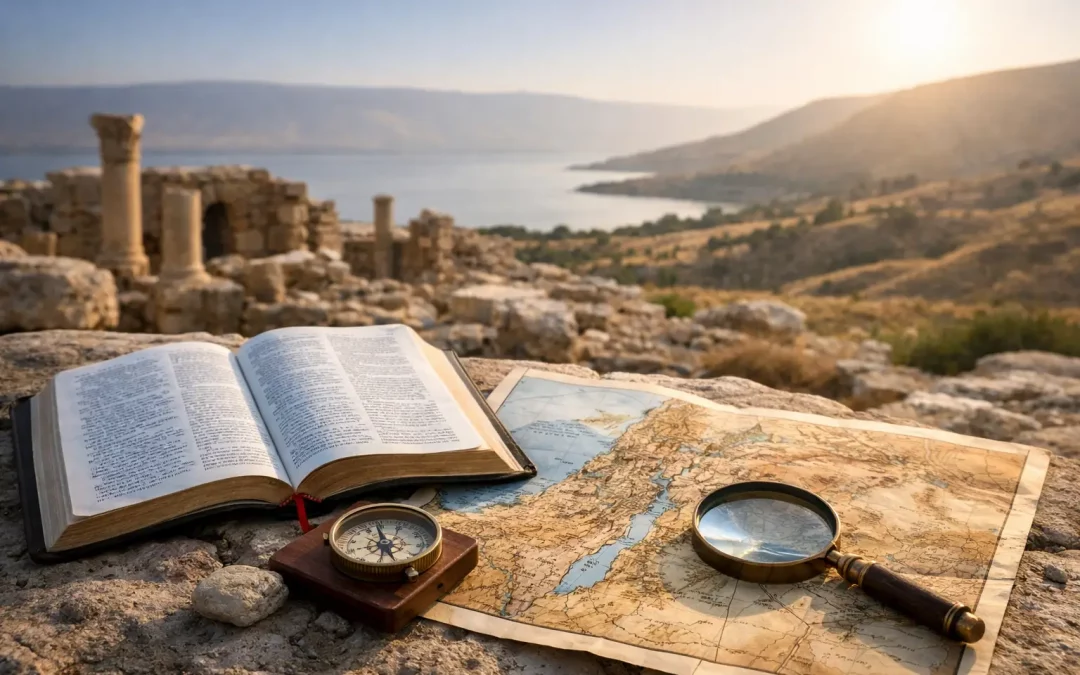
Paul’s letter sent to Ephesus lands differently when we think of Ephesus as a real city. The same is true across scripture. Places in the Bible are not random stage props. They shape the story, deepen the message, and help readers see that the people in scripture lived in a real world under real pressures.
So, to answer the question above – it can matter.
Bible geography and Bible reading
Many readers know the main events of scripture, but the setting can remain blurry. That blur can flatten the story. A journey that took days may feel like a short walk. A city known for trade, idols, and political power may seem like just another dot on a map. When geography becomes clearer, scripture often becomes clearer too.
This matters for simple reasons. Geography helps with meaning, memory, and application. It shows why a route was hard, why a city mattered, and why a region kept showing up in the Bible. Instead of reading disconnected scenes, readers begin to notice movement, tension, and purpose.
Think about the Sea of Galilee, Jerusalem, and the road to Damascus. Each location carries its own weight. A storm on a lake means more when the lake is real. A climb to Jerusalem means more when elevation and distance are in mind. A dramatic conversion means more when the road itself is part of the story.
The land often explains the lesson
The Bible was given through history, and history happened somewhere. That sounds obvious, but it changes how scripture is read. Geography often explains why an event unfolded the way it did.
Israel’s wilderness was not just empty land. It was a hard place, a testing place, and a place of dependence. That setting helps readers feel the pressure of hunger, fear, and waiting. It also helps readers understand why trust in God was such a central issue there.
The same pattern appears in the ministry of Jesus. Towns around the Sea of Galilee were connected by trade, travel, and daily work. Fishermen, tax collectors, and crowds were not gathered in an abstract religious setting. They lived in active communities with ordinary concerns. That makes the calling of disciples feel grounded and near.
Jerusalem matters in a different way. Its height, its temple, and its place in Jewish worship all add depth to key moments in the Gospels. When people went up to Jerusalem, they were not only traveling to a city. They were moving toward the center of worship and expectation. Geography and theology met in the same place.
Bible geography helps readers trust what they read
Understanding the geography of the Bible can strengthen confidence in scripture because it reminds readers that the Bible is tied to real locations, real rulers, and real travel routes. The names are not floating in legend. They belong to the texture of actual history.
That does not mean a map answers every question. It does mean geography can guard readers from treating scripture like a collection of detached sayings. The Bible tells the story of God working in human history. Cities such as Corinth, Philippi, and Ephesus were real places with real cultures. Knowing that can steady faith and sharpen attention.
This is quite helpful when reading Acts. The journeys of Apostle Paul were not vague missionary adventures. They involved roads, ports, and regions with their own customs and pressures. When readers trace those movements, they often notice the courage, patience, and hardship in a fresh way.
Apostle Paul did not preach in a vacuum. He entered crowded cities, crossed dangerous waters, and spoke into places shaped by empire, commerce, and religion. Geography shows the cost of those journeys. It also shows how far the gospel traveled in the early church.
Why Bible geography matters for spiritual growth
This is where the subject becomes personal. Bible geography is not only about information. It can deepen devotion. When readers picture where events happened, they often slow down and pay better attention. Familiar passages begin to feel textured instead of flat.
That can change prayer. It can change imagination. It can change how a person hears the call to faithfulness.
Consider the Psalms that speak of hills, refuge, and wilderness. Those words carry spiritual meaning, but they also come from a physical world. The writers knew rough land, steep paths, and dry places. Their prayers were not vague. They grew out of life in a demanding landscape.
The same is true when reading about storms, deserts, and long roads. Geography helps readers feel the strain of waiting on God in hard conditions. It also highlights how often the Lord met people in those very places. A barren region could become a place of provision. A hostile city could become a place of witness. A prison in a Roman colony could become a place of praise.
The Bible’s settings remind readers that faith has always been lived in real places with real limits.
The journeys of Apostle Paul are a great example
If there is one part of scripture where geography becomes especially vivid, it is Acts and the letters connected to Apostle Paul’s travels. A map can turn a confusing list of cities into a living story.
Philippi was a Roman colony. Corinth was a busy commercial center. Ephesus was a major city shaped by religion and trade. Those details matter because they help explain the challenges Apostle Paul faced and the kinds of issues the churches faced too.
A letter to a church in a port city may reflect a different environment than a letter to believers in an inland region. Social pressure looked different. Religious pressure looked different. Daily life looked different. Geography does not replace spiritual interpretation, but it often strengthens it.
Geography keeps readers from shrinking the Bible
The Bible stretches across regions, nations, and cultures. From Egypt to Babylon, from Galilee to Rome, scripture unfolds across a wide human landscape. That reminds readers that God’s work has never been limited to one small corner of life.
This wider view can shape the heart of a Christian today. It encourages compassion for other peoples, awareness of the global church, and gratitude for how the gospel has traveled across centuries and borders. Reading the Bible with geography in mind can open the imagination to the breadth of God’s mission.
It also humbles the reader. Scripture did not arise in a familiar modern setting. It came through lands, languages, and customs that require patience to understand. That patience is good for the soul. It teaches careful reading instead of rushed assumptions.
A simple way to start paying attention to places
We do not need to become a historian to benefit from Bible geography. A simple habit can make a real difference. When a place appears in a passage, pause and ask what kind of place it was. Was it a city, a wilderness, or a coastal region? How might that setting affect the story?
Another good step is to follow one journey at a time. Read through part of Acts and trace where Apostle Paul went. Notice the distance. Notice the repeated returns. Notice how often the gospel moved through important cities.
Small observations can lead to deeper understanding. They also make reading more memorable. A passage tied to a place often stays in the mind longer.
Why Bible geography matters more than people think
For many Christians, geography seems like an extra detail for study notes or classroom discussion. But it is more than that. It helps readers see scripture as lived history. It gives weight to journeys, color to cities, and shape to the challenges people faced.
More than that, it helps readers meet the Bible on its own terms. The Lord worked through people in actual lands, along actual roads, in actual communities. Paying attention to those places is one way of paying attention to the story itself.
And once the landscape comes into focus, many passages feel warmer, sharper, and closer to home. The Bible still speaks today, but it often speaks with greater force when readers remember where these things happened.
The next time a city name appears in scripture, don’t skip past it. That place may carry more meaning than expected, and it may draw the heart a little deeper into what God is saying to us.