
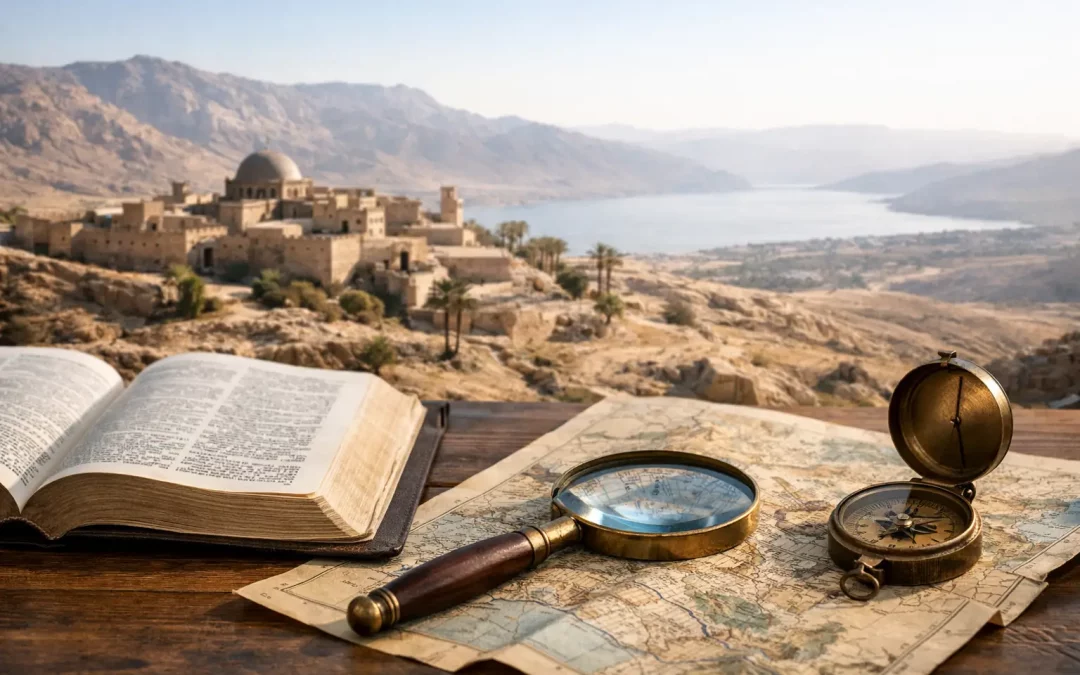
Have you ever wondered how many places in the Bible are actually named?
It sounds like a simple question, but the answer is a little more layered than many readers expect. That is part of what makes biblical geography so meaningful. The Bible is not floating in imagination. It is rooted in real towns, regions, deserts, rivers, islands, and roads where real people walked with God, wrestled with sin, and saw His faithfulness.
How many places in the Bible are there?
While there is no single number, ChatGPT states:
“Most biblical reference works identify ~1,000 to 1,500 distinct place names.”
Why the number changes from one source to another
The biggest reason is classification. Is Eden counted as a geographic place, a sacred setting, or both? Is the Valley of Elah a place in the same way Jerusalem is a place? What about the Sea of Galilee, the Jordan River, or Mount Sinai?
Then there is the question of duplicate names. Some places share names with other places. Some names changed over time. A city might be known by one name in the Old Testament and another in the New Testament era. Transliteration can also affect counting. The same Hebrew or Greek place may appear with slightly different spellings in English.
Another issue is uncertain identification. Archaeologists and Bible scholars have made strong progress in many areas, but not every biblical site has been pinned down with full agreement. Some places are still debated. That means a strict list in one reference book may not match a list in another.
This is one reason a Bible atlas or dictionary can be so helpful. It slows the reader down and shows that biblical geography is not trivia. It is part of understanding the setting of redemption history.
What kinds of places are named in the Bible?
The Bible names many kinds of locations. Some are famous, like Jerusalem, Bethlehem, Nazareth, Egypt, Babylon, and Rome. Others are easy to miss because they appear in one event, one genealogy, or one travel account.
There are major cities tied to kings, prophets, and apostles. There are villages where ordinary life unfolded. There are deserts where people were tested, mountains where covenants were remembered, and rivers that marked rescue, judgment, or crossing into promise.
There are also regions and nations. Israel, Judah, Samaria, Galilee, Moab, Edom, Assyria, and Macedonia are not just background labels. They help readers understand conflict, movement, mission, exile, and return.
The New Testament adds another layer through travel. The book of Acts alone introduces a wide sweep of ports, islands, Roman provinces, and urban centers. When Paul traveled through places like Philippi, Thessalonica, Corinth, Ephesus, and Malta, the gospel was moving through the roads and sea lanes of the ancient world.
How many places in the Bible can be identified today?
A large number can be identified with reasonable confidence, though not all with the same level of certainty. Jerusalem, Jericho, Bethlehem, Nazareth, the Dead Sea, the Jordan River, and Rome are well known. Many sites tied to Paul’s journeys are also widely recognized.
Still, some biblical locations remain uncertain or debated. That is especially true for smaller towns, ancient ruins with limited evidence, or sites where names shifted over centuries. Sometimes scholars can narrow a location to a region but not a precise spot.
This is where humility helps. The Bible was not given mainly to satisfy modern mapping curiosity. Yet the geography it includes is still valuable. Even when a site cannot be identified with complete certainty, the repeated naming of real places still anchors the Bible in lived history.
Reading the Bible with geography in mind
There is a simple way to begin. Notice every place name in the passage instead of passing over it. Ask what the place tells you about the event. Is it a border area? A center of power? A wilderness? A hometown? A place of exile, worship, trade, or danger?
Then ask a second reflective question: what does this setting reveal about how God was working there?
For example, wilderness places often carry themes of testing and dependence. Cities can highlight influence, idolatry, conflict, or mission. Mountains may point to worship, revelation, or covenant moments. Seas and storms often expose fear and dependence. Geography is often part of the message, not just scenery.
For readers who want to grow in this area, even a simple Bible map in the back of a printed Bible can make a difference. Looking up one or two locations during a reading session can turn a familiar passage into something more alive and concrete.
John Christopher Frame’s work often encourages this kind of biblical awareness, especially where Scripture, discipleship, and the lands of the Bible meet in a practical way.
So what is the best answer?
If someone asks, “How many places in the Bible are named?” the best short answer is this: there are likely well over 1,100 named places, and some counts go beyond 1,500 depending on what is included.
The Bible tells the story of God’s work across lands, cities, deserts, and nations. Every named place is a reminder that the Lord has been at work in human history for generations.
The next time a place appears in Scripture, pause before moving on. That one location may carry more meaning than it first seems, and it may open your heart to see the Bible with fresh wonder.